Security companies
The first tethered drone sold the way you sell guarding.
A monthly subscription with uptime, hot-swap and support written in; verified alarms into your SOC instead of raw video; one operator for ten sites; white-label monthly reports for each client. Aviation and GDPR paperwork done once, not per site.
Industrial sites and construction
One box replaces the night guard and the camera mast.
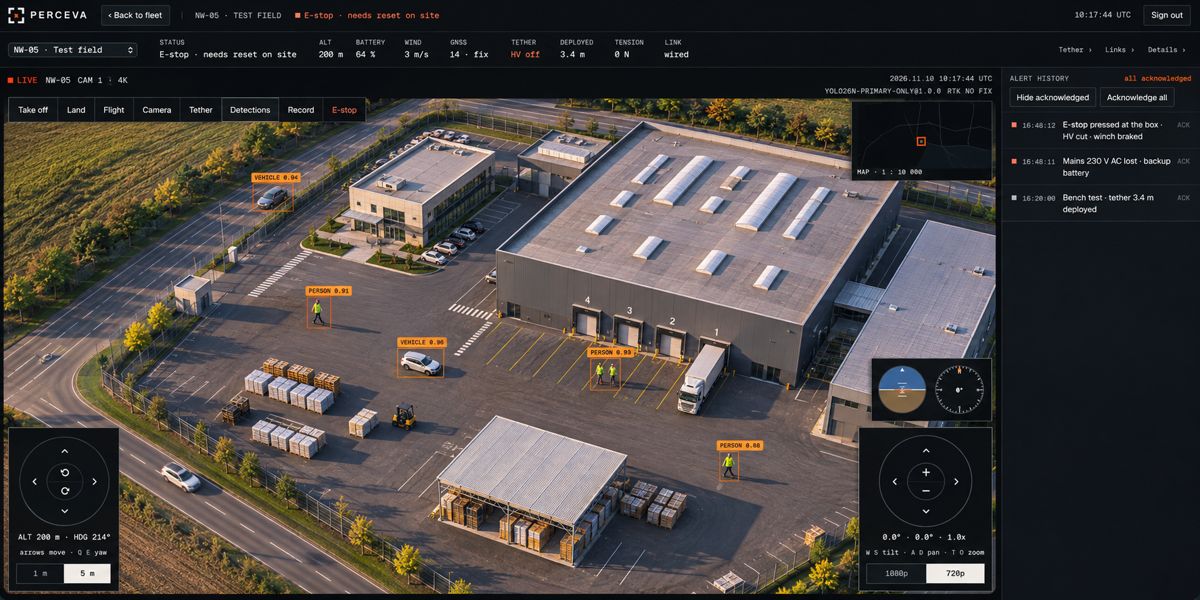
A camera at 100 m that watches the whole site and tells you what happened: a helmet missing, someone inside the crane's swing radius, a vehicle at 03:00. Alerts on your phone in seconds, from site power, with nobody trained to fly. Priced like a camera contract, not a guard post.
Police and public events
Overwatch from the patrol car that holds up in court.
Airborne within minutes of arriving, one live picture shared by link to the command post, every frame timestamped, georeferenced and tamper-evident. No licensed pilot on the shift.
Border segments
Holds position with no GNSS, and says by how much.
Jam the satellites and the radio and it stays where you put it: position comes from the tether, video and control run down the fibre, no radio communication is needed. We publish the drift figure; others say "resistant". Two people move it along the line in minutes.
Forward positions and convoys
Three times the power on the line, 100 m up, built in the EU.
3 kW over the tether lifts a radio relay and an EO/IR gimbal at the same time. Sealed IP67/IP68 panel connectors, controlled landing on tether or power loss, made in the EU with a documented supply chain.
Wildfire monitoring
A fire lookout that never blinks, where there is power but no tower.
A camera at 100 m sees over the canopy and scans a fixed sector around the clock on a 3 kW generator or a line at the edge of the forest. A thermal option spots a hotspot before there is smoke to see; the alert carries the bearing and a frame, so a crew is sent to a place, not a direction. Stays up through the season, moves with the risk map.
Analytics performance (accuracy, false-alarm rate, latency) is published per rule once measured; until then the site states the rule, not the number. Defence and border detail is in a separate brief, on request.